Take your personality test for the job interview.
Understand who you are, and the interview stops being frightening. Almost nobody has ever seen themselves from the outside. And the questions people fear most — "your strengths and weaknesses", "tell me about yourself" or "where do you see yourself in 3 to 5 years?" — are at bottom questions about self-knowledge. If you know yourself, you answer with confidence and you sound mature.
How they see you, in one sentence
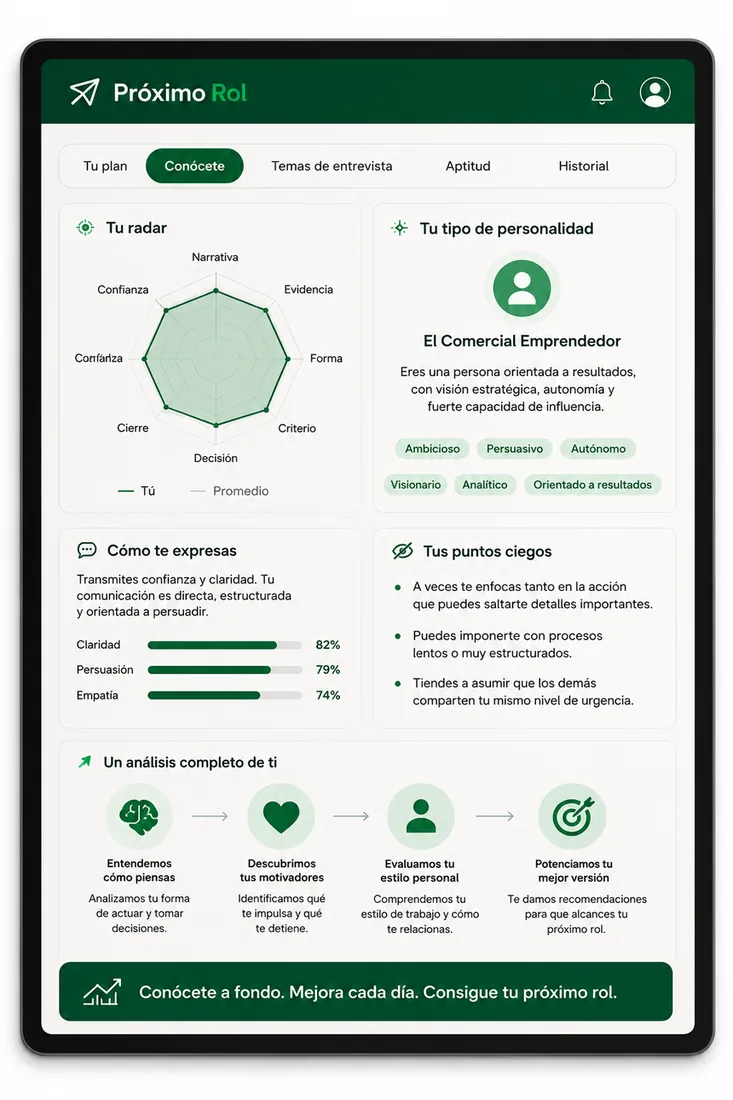
Read the impression you leave when you speak: "you convey energy and conviction, but your pace can read as a lack of structure". It is what the other side thinks and never tells you. Having it in writing lets you lean on what works and watch what plays against you.
Your archetype
It puts a name to your style and shows you how you mature interview after interview. It is directly useful for "tell me about yourself": you stop hunting for words and already have a story of your own, authentic and in order.
Your communication fingerprint
The one thing you can never hear about yourself: do you speak too fast? Are your answers too short or endless? How many filler words do you use? Do you come across as nervous? We measure it for you. Fixing this is usually what raises the impression you leave fastest.
What drives you and your blind spots
Your motivations and values (to pick companies that fit and to sound genuine), and, honestly and kindly, how you can be misread. So that you know it before the interviewer does.
An honest mirror almost nobody has of themselves
All of this builds itself, out of your practice sessions, and evolves with every interview. It gives you language and self-awareness about yourself, and in an interview that reads as maturity, which is exactly what they are looking for.
- It updates with every new interview.
- It helps you answer the personality questions with confidence.
- It stops being "I don't know why I'm not connecting" and becomes a plan.
Your psychometric profile, without sitting down to take a test
A psychometric assessment measures two things: what you are like and how you reason. Proxi looks at them through three routes, and only one of them is a test.
The personality test
The classic one, with the big five traits: openness, conscientiousness, extraversion, agreeableness and stability. You answer it once and it gives you back your profile in writing, not five coloured bars.
How you actually answer
Your archetype comes out of your interviews: what drives you, how you communicate and where you can be misread. A test says how you think you are; this says how you sound when you are asked.
How you reason
The other half comes from the aptitude exercises: numerical, logical and verbal, with their difficulty. Not to give you a mark, but to tell you which material you reason best with.
That is the difference from a traditional assessment: that one evaluates you for an afternoon and hands you a number. Here the test is the starting point and the rest is built while you practise, so the profile changes with you. And all of it is threaded into your professional timeline, which is where your story stops being a list of jobs and starts having a thread.
What people who prepared with Proxi say
"I arrived with no idea how to organise what I wanted to say. They helped me bring the anxiety down and get my message clear. I finally came across as myself."
 Laura Sánchez
Marketing Analyst → Growth Manager · Madrid
"I had the experience but I did not know how to show it. They helped me put numbers and context around my achievements."
 Daniela Matamala
Coordinator → Senior Project Manager · Bogotá
"They teach you how to interview properly. They walk you through every detail and answer every question, however small."
 Fernán Urrutia
Financial Analyst → Deputy Finance Manager · Santiago