Put your cover letter together in seconds.
Share the role you are applying for and Proxi writes your letter for that job, using your CV, your career and the way you write. It is not a template with your name on top: it is your letter.
How it works
You share the role you are applying for
Paste the job ad, or just the company name if nothing has been posted yet. The more context you give it, the more professional the letter comes out.
Proxi writes the letter for you
It uses your CV, your career and the way you write to choose what to say about you for that specific job.
You edit it and make it yours
It hands you a draft, not a finished text. The last pass is always yours, and adapting it to the next role is one click away.
All your letters, in one place
Each one is saved with its company and its role. You open them, compare them and reuse the one that worked best. And every letter you edit teaches Proxi how you write.
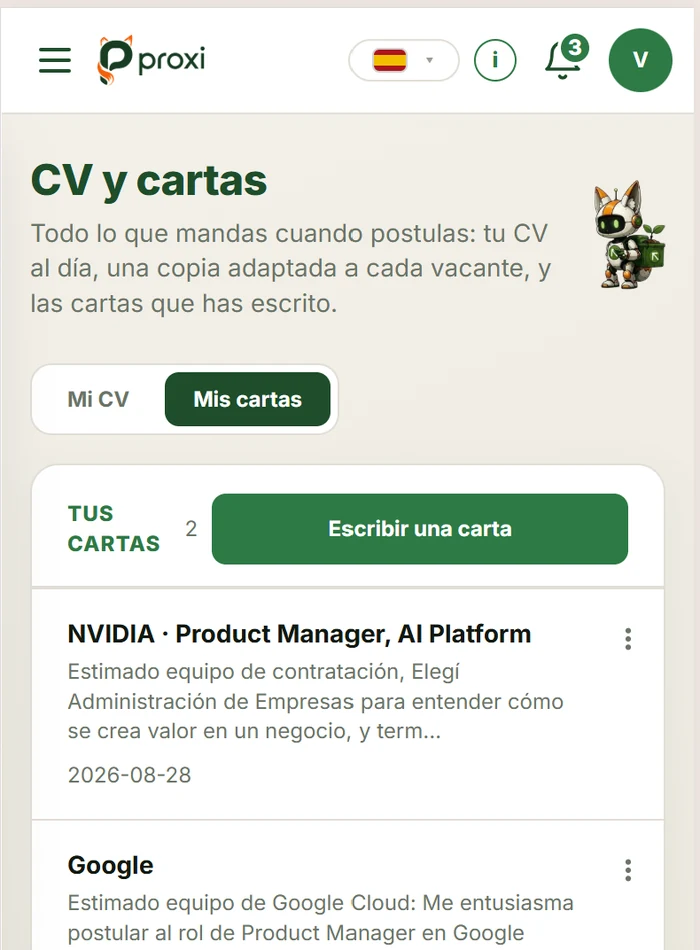
1 · All your letters in one place. Each with its company and its role. You start a new one right from there.
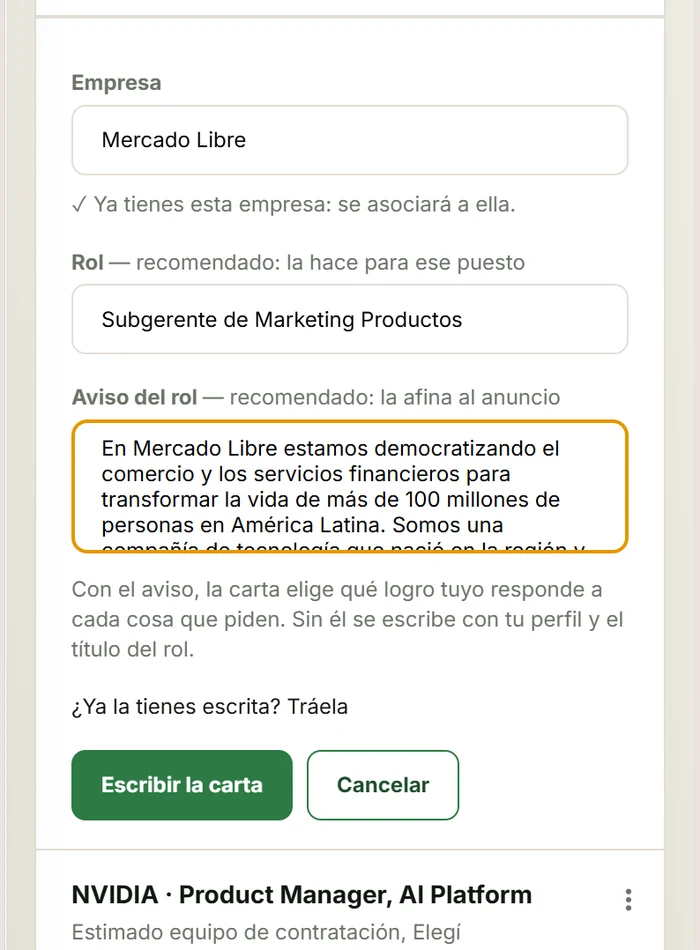
2 · The only part you fill in. The company, the role and the ad pasted in. With the ad, the letter picks which of your achievements answers each thing they ask for.
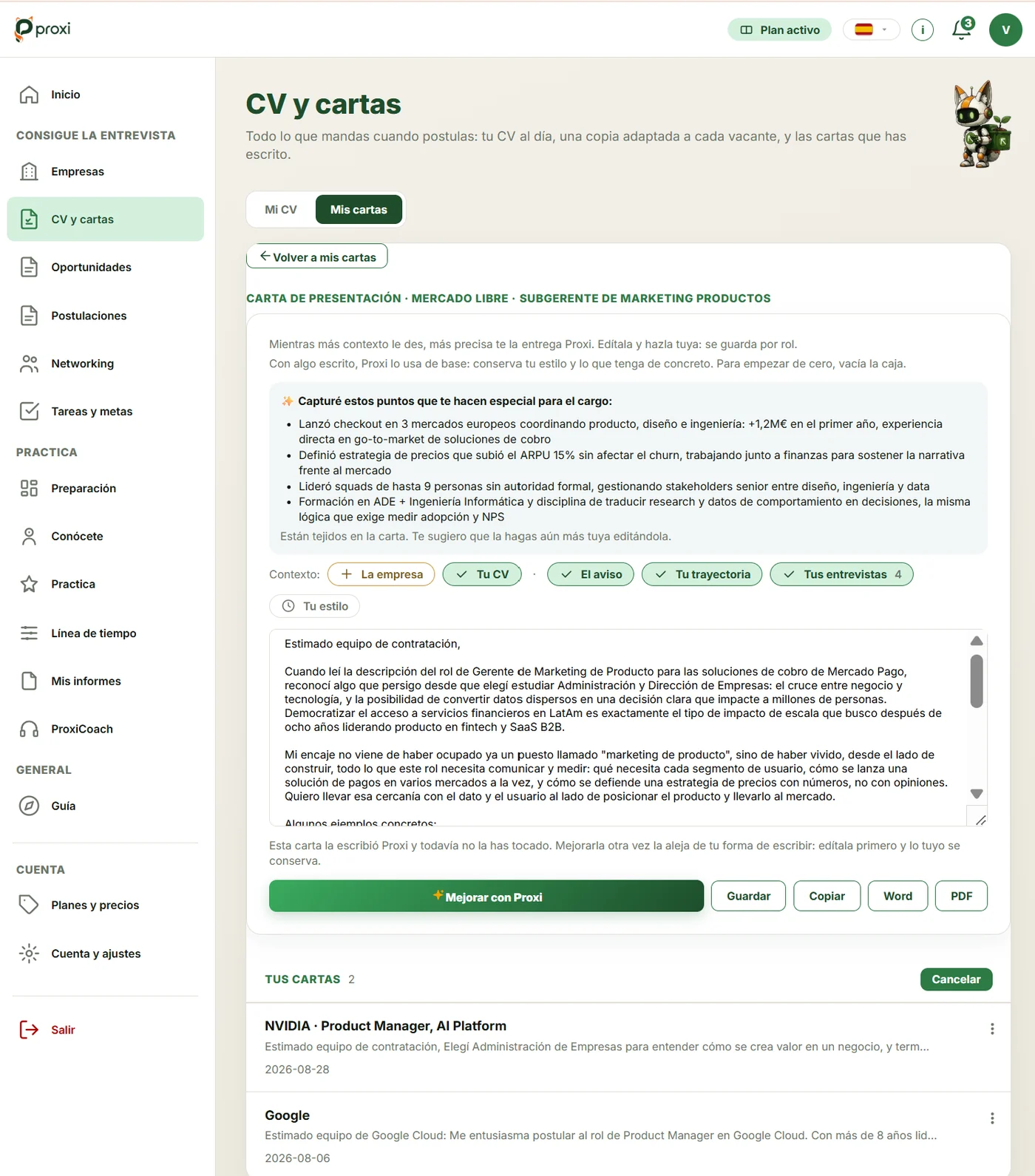
3 · Proxi writes it and tells you what from. The four points it chose to tell about you for that job, and the context row with the material it used. What you see on the left is the rest of the app: the letter is one piece, not the whole product.
We have hundreds of letters behind us and we know where a mass-produced one shows: the opening line that fits any vacancy, the achievement with no number, the textbook sign-off. Proxi is tuned to write none of the three.
Your tenth letter is better than your first
Almost every letter generator writes from whatever you paste into a box that day. Proxi writes from what it already knows about you, and it knows more every time you use the app.
Your CV
The one you uploaded or the one you built inside Proxi: both count. That is where the concrete achievements come from, with their context and their number.
Your career, with its reasons
Not just where you were, but why you moved each time. That is what makes the opening talk about real motives instead of «I am writing to express my keen interest».
How you answer in interviews
Every practice you complete updates your profile: the app re-reads all your interviews together and sharpens what kind of professional you are. The letter is written from that portrait, not from one three months old.
How you write
If you have already written a letter by hand, Proxi learns your register: how formal you are, how direct, how you sign off. And it writes in that style. Only the style: not one fact from that letter is copied into this one.
And the limit is explicit: the job ad is there to decide what to highlight, but it is not evidence about you. Nothing that appears only there is attributed to you as your own experience.
What a letter that actually gets read has
Almost every letter says the same thing because it comes out of the same mould. These are the four things that separate a letter that opens a door from one that is filed unread. All four come from your own story, not from a format.
It talks about that job, not about every job
The first line has to make clear you read the ad. If your letter works just as well for another vacancy, it works for none.
It says why that company
A real, concrete reason, however small. That is what separates interest from mass mailing.
It proves what it claims
No «results-oriented». An achievement with its context and its number, even if the number is modest.
It sounds like you
Written in your register, with no textbook phrases. That is why the letter comes out as a draft: the last pass is yours.
Three hard situations, and how they are solved
When you have no track record in the field
The letter cannot open with an apology. It leans on what you did do: a project, some volunteering, a job in another sector with the same demands. And it explains what of that carries over to this role.
When you come from another sector
What you have to tell is not the jump, it is the thread: what you know how to do that is needed there too, and why the change makes sense now. Without that, your CV looks like a filing error.
When it is your first application
Studies, yes, but above all evidence: what you built, what you organised, what you taught yourself. It shows far more than a list of modules.
And one thing almost no tool does: if the letter drops a number that is not in your evidence, Proxi flags it before you send it. A letter goes to the company that wrote that ad, and an invented number does not stay at home.
People who have been through this
"I had the experience but I did not know how to show it. They helped me put numbers and context around my achievements."
 Daniela Matamala
Coordinator → Senior Project Manager · Bogotá
"I arrived with no idea how to organise what I wanted to say. They helped me bring the anxiety down and get my message clear. I finally came across as myself."
 Laura Sánchez
Marketing Analyst → Growth Manager · Madrid
"They teach you how to interview properly. They walk you through every detail and answer every question, however small."
 Fernán Urrutia
Financial Analyst → Deputy Finance Manager · Santiago
Frequently asked questions
How much does it cost?
You start without paying anything. If your interview is this week, the Express costs €6.90 for seven days; monthly plans start at €15 and there is no lock-in. With either one you write, edit and take away every letter you need, each one for its own vacancy.
Does it write for that specific company or is it a template?
It reads the ad you paste and crosses it with your CV and your career: it picks which of your achievements answer what that job asks for. If you do not paste the ad it still writes one, from what it knows about the company and your goal, but it comes out more generic.
Can I edit it afterwards?
Yes, and you should. Proxi hands you a draft; the last pass is yours. It is saved next to that company and that role, so you can pull it back up whenever you want.
Do I need my CV uploaded?
Yes, and for a concrete reason: the achievements with their context and their number come from there. Without them the letter would talk about you «in general», which is the one a recruiter files without reading. You can upload the one you have, and if you have none you build it from scratch inside Proxi, guided step by step and ready to clear an ATS filter.
Does the letter improve as I use the app?
Yes. Every interview you complete updates your profile: Proxi re-reads all your interviews together and sharpens what kind of professional you are, and the letter is written from that portrait. The same goes for your CV and for your own letters, from which it learns how you write. The fuller your profile, the less generic it comes out.
Does it work for any job and any country?
Yes. You can work in Spanish, English, Portuguese or French, and the letter adapts to whatever job you point it at, in whatever country.
Can people tell an AI wrote it?
It comes out of your real experience and in your register, so it does not sound like a form. We have hundreds of letters behind us and Proxi is tuned for exactly that: no openings that would fit any vacancy and no textbook sign-offs. And if a number shows up that is not in your CV or your history, we flag it so you can check it before sending.
The letter is the first step, not the only one
With the same account, and without paying anything more to start:
Find who to write to
Companies that fit your profile, with the outreach message ready, sorted in a pipeline instead of a loose spreadsheet.
Practise the interview
You rehearse out loud with questions from your role and walk away with an analysis of how you answered, not with a «that was fine».
Walk in with backup
ProxiCoach supports you during the real interview, in plain sight of the interviewer and with your consent.