Most people prepare for an interview in the worst possible way: googling "common questions" the night before and memorising isolated answers. The result is a candidate who sounds rehearsed, goes blank at the first unexpected question, and leaves thinking "I should have said that differently".
Preparing properly for a job interview is something else. It isn't stockpiling answers: it's walking in with a structured story about who you are, why you're there and what you bring. This guide is the exact order we work through with our clients — professionals who have sat on both sides of the hiring table — so you arrive on the day with everything built and rehearsed, not memorised.
Throughout the guide you'll see boxes showing how we do it in ProxiCoach. Not to sell you anything: to show you why each step trains better once they stop being isolated exercises and become one connected process.
Before you start: where you actually stand
Almost nobody really knows how well they're doing. You think you've got telling your experience covered, that "I'll wing that on the day", and so you downplay preparation. It's the most common trap.
Because here's what you don't see: plenty of people do prepare. You're competing with people who have polished their careers, who have more experience and solid references, and who arrive having prepared with discipline. Against that, improvising isn't enough. Being good isn't enough: you have to be able to show the best of yourself in the short time an interview lasts.
The good news is that this can be trained, and if you're reading this guide you're already ahead of most. Let's go step by step.
Step 1 · Research: the company and whoever will interview you
Research comes first for a practical reason: it's what lets you organise your answers. When you know what the company is looking for and who's in front of you, you know which parts of your story to bring forward and which to leave out.
"Why do you want to work with us?" comes up in almost every interview, and almost everyone answers it badly, with generic flattery that would fit any company. A good answer does three things at once:
- It's honest. There has to be something real driving you. Faked enthusiasm is spotted in seconds.
- It proves you did the work. Study the company properly — its product, its moves, its sector — and mention something specific.
- It connects back to you. It isn't enough to say why the company is good; say why tú benefit from working there. An interview is a two-sided fit.
Research your interviewer too. Almost nobody does, which is exactly why it works. Look up their track record on LinkedIn, where they've been and what they've built — not to flatter, but so you can say something as simple as "I saw you worked at A and B, and it struck me you'd be someone I could learn from and contribute alongside". That gesture says you're taking the process seriously.
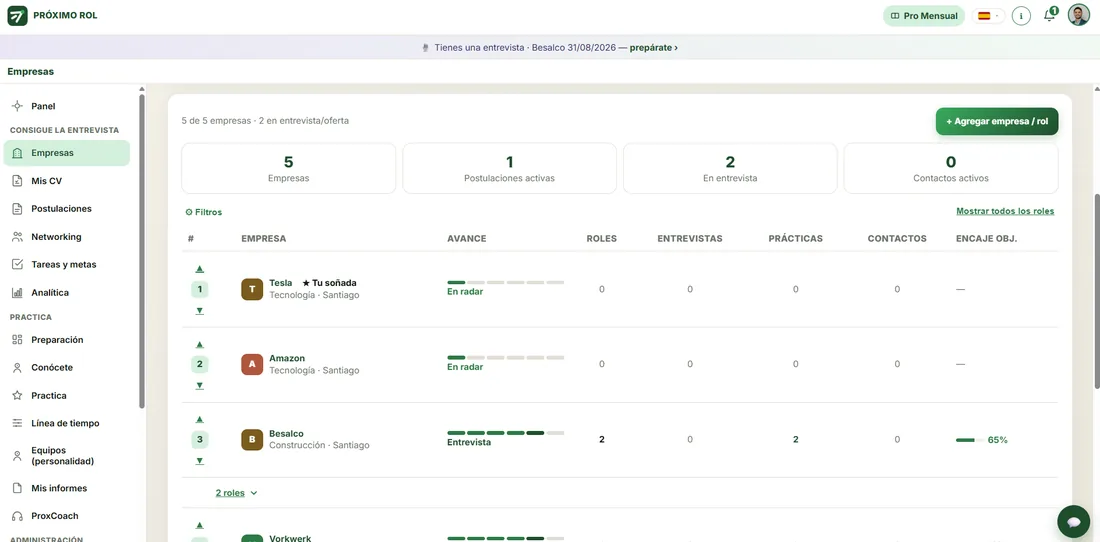
ProxiCoach is a free app for preparing for interviews: it brings every step of this guide together in one place, connected to each other. Here, for example, you save each company you're targeting, and the tool gathers its mission, trends, news and a "why this company" you can edit. So you don't start from a blank page: you arrive with context and organise your answers around it. (Researching the interviewer is still your job, and it's worth it.)
Step 2 · Build your career timeline
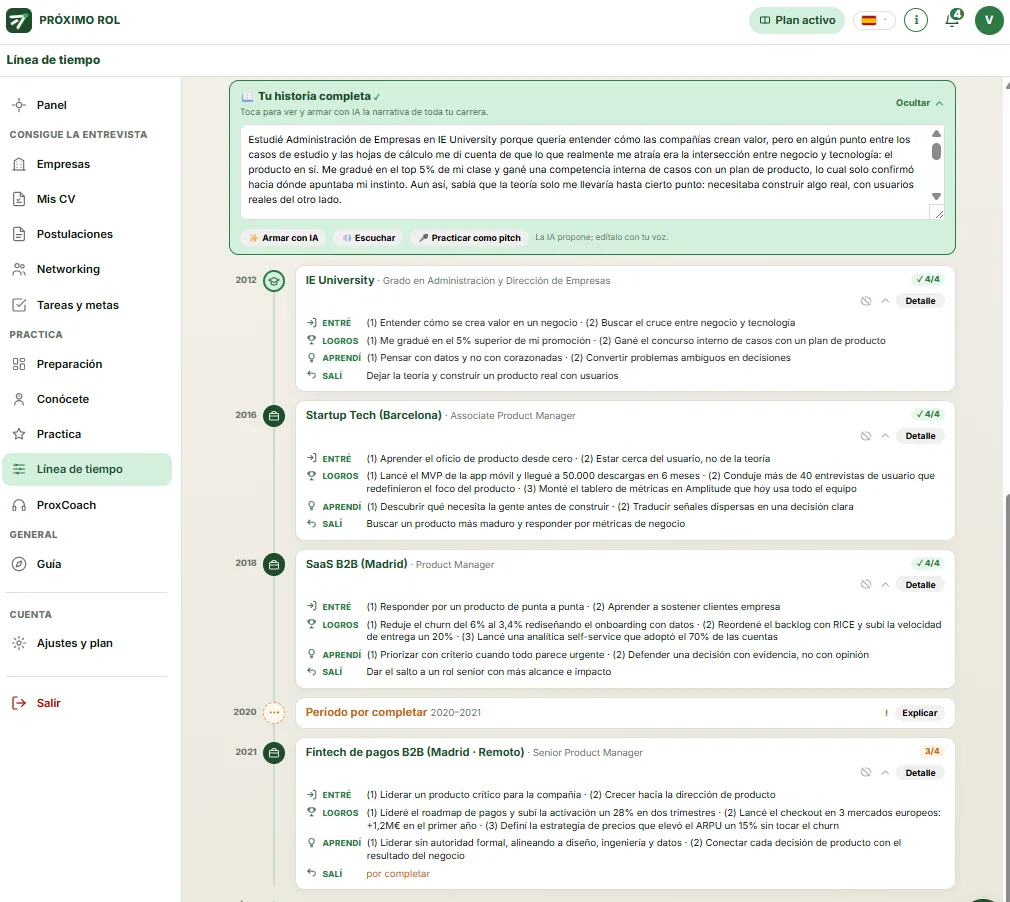
We all know our own story. But knowing it isn't the same as seeing it: when you write it out as a timeline and examine specific aspects of each stage, it stops being a hazy memory and you start seeing it both as a whole and in its parts. That's why the single most useful exercise in the whole preparation is a simple one: make a timeline of your career.
Write down every place you've been, from your beginnings to today. And at each stop, answer:
- Why did I go there, and what motivated me?
- What did I learn?
- What did I achieve? (with numbers wherever you can)
- Why did I move on to the next step?
It's a simple exercise, but it does something no isolated piece of advice achieves: it gives you the structure of your narrative. Suddenly you stop having a list of jobs and start having a story with logic, with the whys that connect each stage to the next. Everything that follows is built on this timeline.
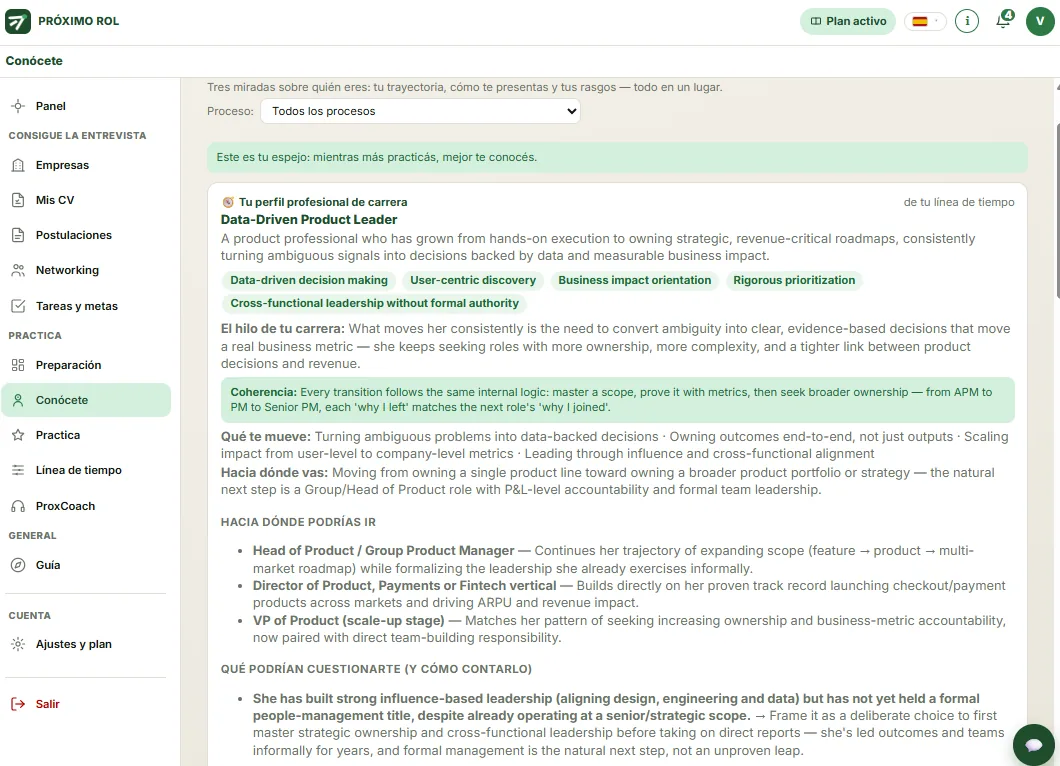
This is the heart of the method. Your CV seeds a first draft of the timeline, and you complete it with those whys. On that basis, the tool can synthesise your professional profile: what kind of professional you are, the thread connecting your career, what drives you and where you're heading. It's what turns "a list of jobs" into "a story with direction".
Step 3 · Tell your story out loud and listen to yourself
Now take that timeline and tell it out loud, stop by stop. Saying it aloud changes everything: an idea that sounded clear in your head often tangles the moment you put it into words. You only find that out by speaking. And here comes the key part: listen to yourself. You'll notice filler words, detours and sentences that don't land — ones you didn't know you had.
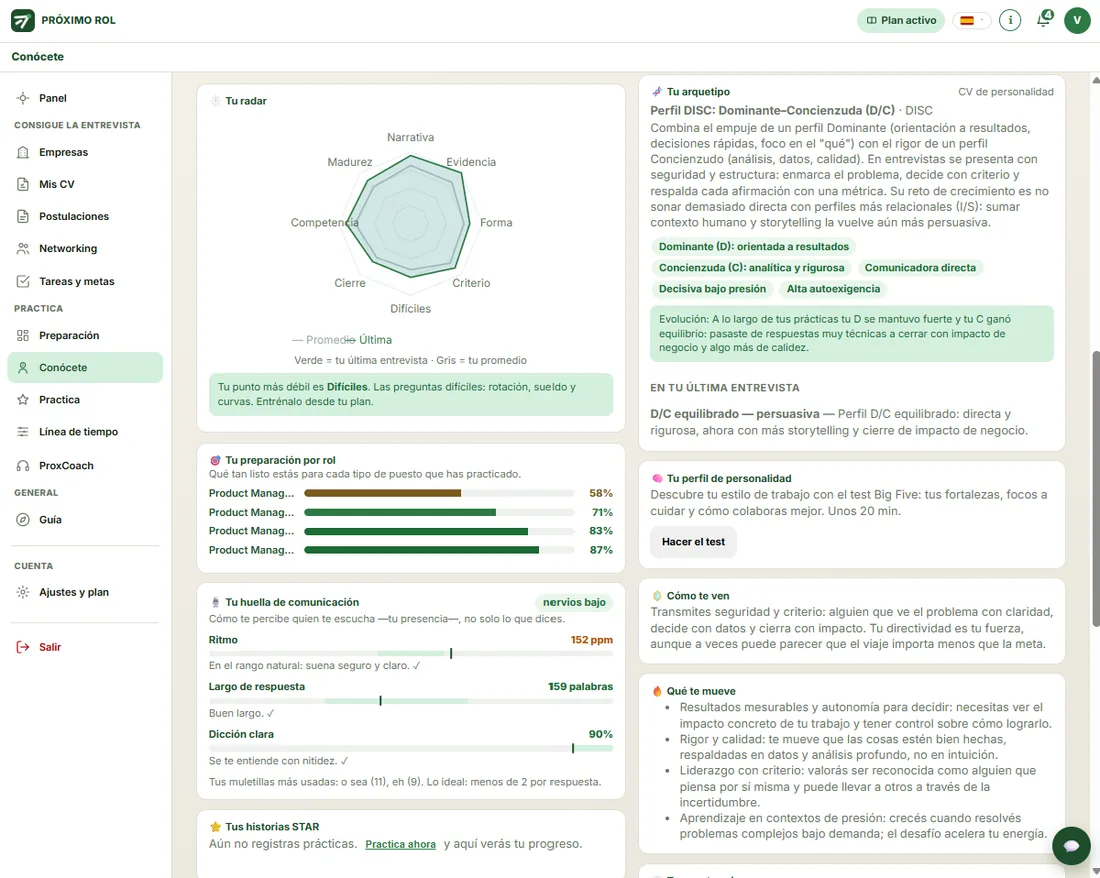
Instead of just recording yourself on your phone, you do a voice interview with an AI that measures how you actually communicate: your pace (the sweet spot is around 130–150 words per minute), your most-used filler words, how clearly you articulate, and even an estimate of your nerves. It isn't a generic "you did well": it's an X-ray of how you sound, which is exactly what you can't see for yourself.
When your story has a clear structure, everything else falls into place: every subsequent answer comes from the same source and sounds coherent. When it doesn't, every answer seems improvised even when it's technically correct.
Step 4 · Prepare your short pitch
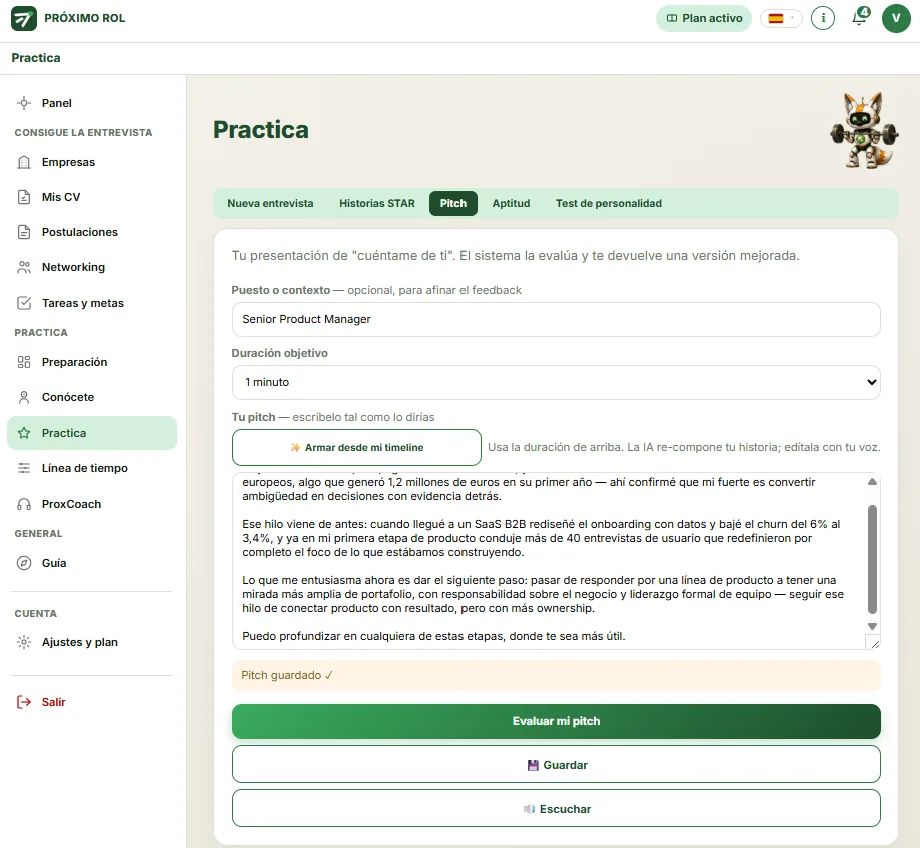
The interview almost always opens with "tell me about yourself". With your timeline ready, the pitch no longer comes out of nowhere: it's the condensed version of that story. It's short: between 30 and 90 seconds. It doesn't tell everything, it opens the conversation. The formula the experts recommend (Time, The Muse, IESE) is Present → Past → Future:
- Present: who you are today, with a recent achievement that carries weight.
- Past: two or three milestones (not the full list) proving you can handle this role.
- Future: why you're excited about this opportunity, connecting your track record to the job.
Descriptive, energetic and in the first person. And close with a bridge that hands control back to the interviewer, instead of trailing off.
(Present) "I'm Laura, and I currently lead marketing at an e-commerce startup. Over the last year I redesigned the content strategy and went from 8,000 to 35,000 monthly visits, cutting cost per lead by 40%."
(Past) "I come from the data side. I started as an analyst, and that's where I learned to decide by looking at numbers, not instinct. That's what sets me apart: I understand the funnel from both the creative and the metrics end."
(Future) "That's why this role interests me: you're scaling acquisition, which is where I've contributed most. Doing it at a bigger scale excites me."
(Bridge) "That's the summary. If you like, I can walk you through my track record in whatever order is most useful to you."
Notice what no in: she doesn't explain why she left each job or list her roles. All of that — the whys from your timeline — comes after the bridge. Compare it with the typical mistake, the "shopping list":
"Well, I studied marketing, then I joined X where I spent two years but I left because the atmosphere wasn't good, then I moved to Y where I did this and also handled the social media side…"
Present → Past → Future, with an achievement that carries weight, in the first person, closing with a bridge. It opens the door; the walk through your story is where you demonstrate judgement.
Since your timeline is already structured, the tool builds a first pitch with you using this same formula (Present→Past→Future, with a bridge). It isn't there to be recited: it's a draft you make your own and rehearse until it sounds natural.
Step 5 · Train situational stories with the STAR method
A good part of the interview is competency questions: "tell me about a time when…". Here the most common mistake is describing what you used to do ("I was responsible for", "I coordinated") instead of telling what happened because of you. Impact is the only thing anyone remembers.
"I was responsible for content strategy and coordinated with design."
"I redesigned the content strategy and went from 8,000 to 35,000 organic visits in 9 months, cutting cost per lead by 40%."
Prepare three to five stories with the STAR method (Situation, Task, Action, Result). Your timeline already has the raw material: the achievements from each stage. The full detail is in The STAR method: how to answer competency questions.
STAR stories are built from the achievements you already loaded into your timeline, and when you practise one, it stays linked to the experience it came from. Your preparation doesn't live on scattered sticky notes: everything points at the same story.
Step 6 · Set your salary expectations
Sooner or later the money question arrives. Don't improvise a figure on the spot. Before the interview, define your three numbers:
- Minimum: below this, accepting isn't worth it.
- Target: what you actually want, justified by the market and your experience.
- Anchor (opening): between 10 and 20% above your target. You start here.
When you say it, do it from the value you bring, not from what you need: a specific number, calmly, and then silence. The full mechanics are in How to negotiate your salary without sinking your application. Read it before your interview: it can be worth a lot of money.
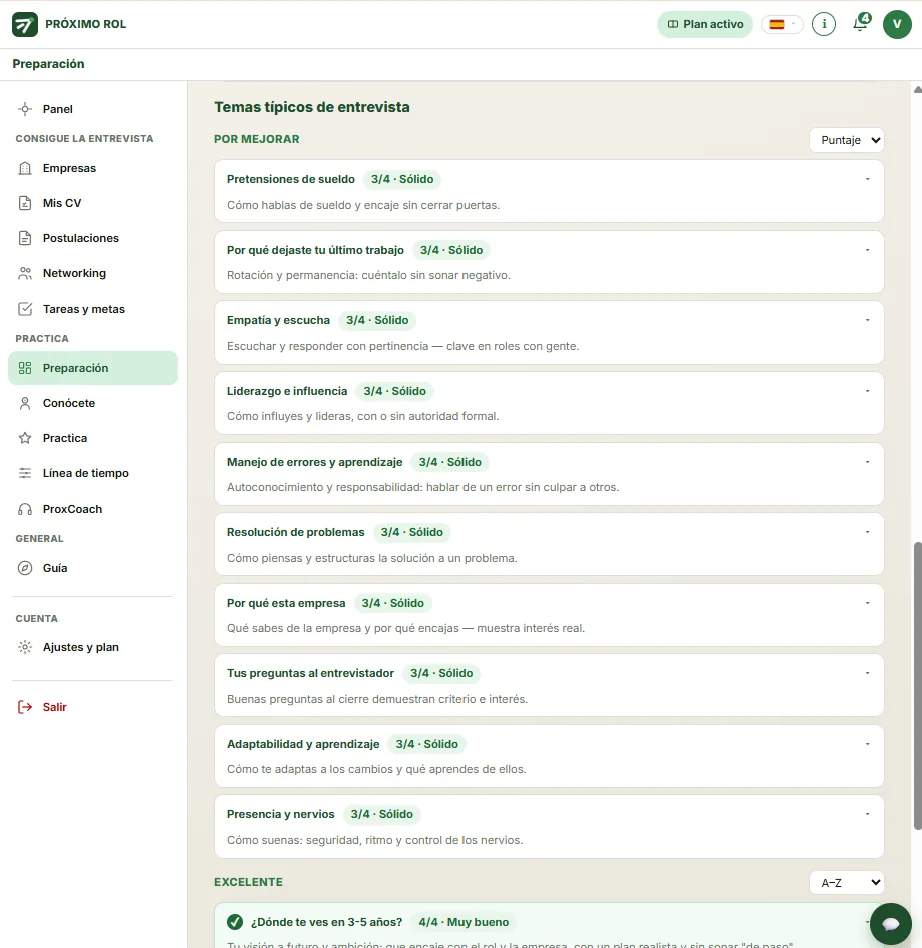
You save your three numbers per company and get an AI coach that helps you prepare how to say them for that specific role. The salary question stops catching you off guard.
Step 7 · Prepare your own questions
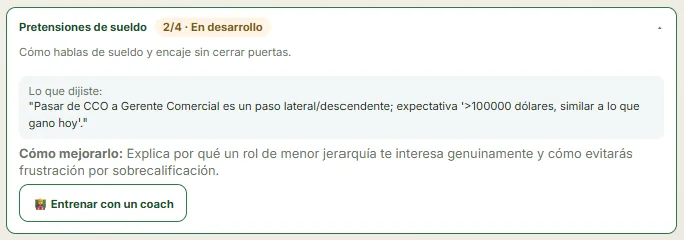
At the end there's almost always the "do you have any questions for us?". Having none signals a lack of interest. Good questions show you've thought seriously about the role:
- "What set apart the person who performed best in this role?"
- "What's the team's biggest obstacle right now?"
- "What would you expect to see from me in the first 90 days?"
The questions you ask say as much about you as the ones you answer.
From your company research, the tool proposes your own questions and an opening for the conversation. You review them, pick the ones that sound like you, and arrive with judgement instead of an awkward silence.
Step 8 · Practise with a mock interview under pressure
Training your story serves to build. But before the real day you need to put it to the test under pressure, and that only happens with someone in front of you. A great way to start is running a mock interview with a friend you trust: it forces you to answer in real time and gives you honest feedback. The first time you feel that pressure cannot be on the day of the interview.
That said, a friend has limits: they don't know the exact questions for that role, they don't always know what to assess, and out of affection they tend to go easy.
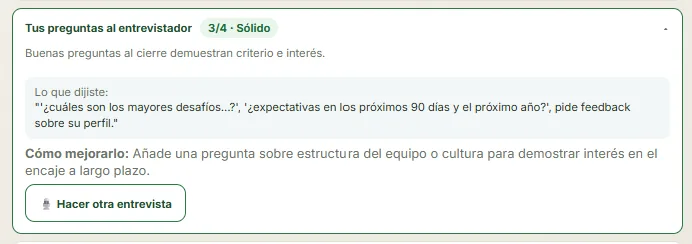
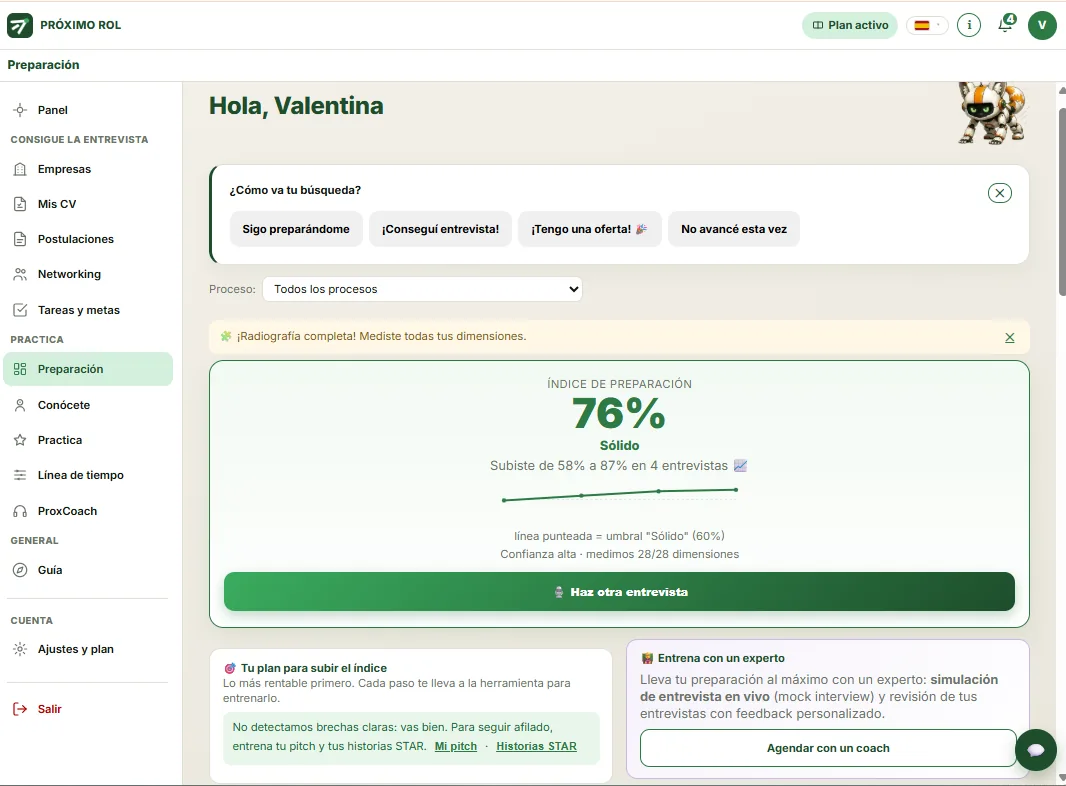
AI interview practice systems already exist, and they're a good start. In ProxiCoach we went a step further: the interview is built around you, with real questions based on your CV and the role, and at the end you get a report that measures you against a rubric: not a "well done", but which dimensions you're failing on, how ready you are and what to train first. You also see your progress after each practice session.
And if you prefer the human touch, we can also work with you through 1:1 coaching with people who have sat on both sides of the table. You choose: train on your own with the AI, or with someone beside you. Your first practice interview, with its report, is free.
Step 9 · Mind your mindset, logistics and presence
With the story and the answers ready, the details that also decide things remain:
- Nerves: if you've already practised under real pressure, the day itself is almost déjà vu. Preparation is the best remedy for nerves.
- Logistics: if it's online, test your camera, mic, connection and background beforehand; keep water to hand and your CV in front of you. If it's in person, arrive with time to spare.
- Presence: tone, pace and body language communicate as much as words. Speak more slowly than you think you should; silence to think is fine.
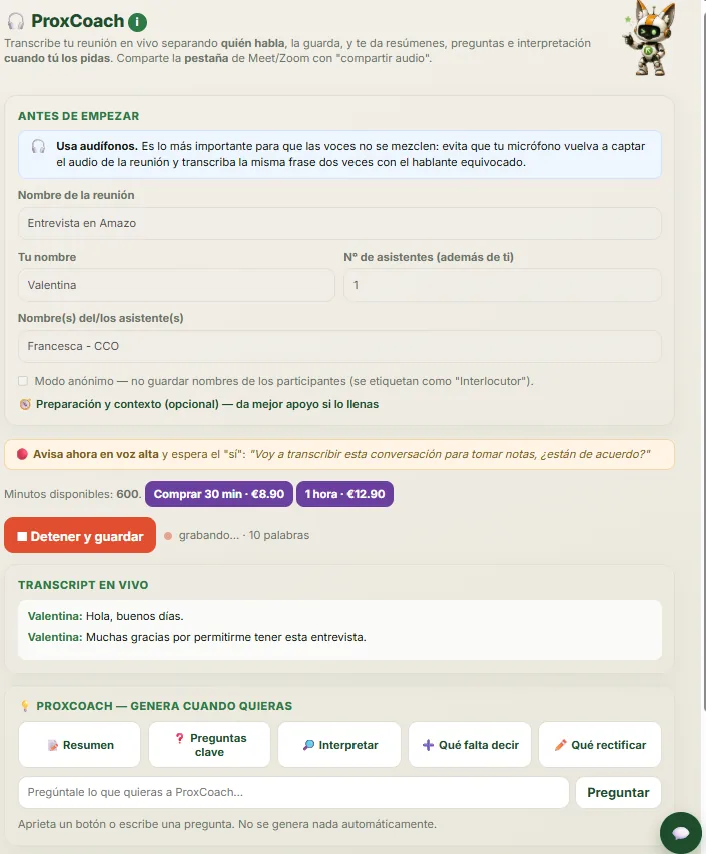
On the day of the real interview you don't go in alone: you go in with your personal assistant. During the conversation it captures the online interview, keeps all your notes to hand and gives you advice in the moment: it flags anything that wasn't clear, reminds you of the achievement or message you should be emphasising, and suggests how to answer better on the fly. Like having a discreet coach beside you, live.
Many hiring processes include logical, verbal or numerical tests. These can be trained too: short, frequent sets and reviewing your mistakes beat a marathon the night before.
It isn't just getting the job: it's understanding your path
Here's the shift in perspective that separates whoever "passes the interview" from whoever builds a career that makes sense. All this preparation — your timeline, your narrative, your voice — doesn't only serve this process. Done well, it gives you back something more valuable: a clear picture of who you are as a professional.
What kind of profile you have, the thread connecting your decisions, what really drives you, what makes you different and where you're going. That clarity doesn't only show in an interview: it also helps you choose better what to aim at, and to reach your next role knowing why you want it.
As you complete your story and practise, the tool brings all those views together in one place — your career profile, your competency radar, how you communicate, your archetype and your traits — so you can see yourself from different angles. It's a mirror: the more you practise, the more complete it gets. And that self-knowledge is, in the end, what shows most in a real conversation.
Final checklist before your interview
- I researched the company and know, specifically and honestly, why I want the role and what I get out of it.
- I researched my interviewer and can connect with their background.
- I made my timeline: why I joined, what I learned, what I achieved and why I moved on.
- I told my story out loud and listened to myself.
- I have my short pitch (30–90 s, Present→Past→Future, with a bridge).
- I have 3–5 situational stories in STAR with quantified achievements.
- I have my three salary numbers and know how to deliver them.
- I prepared my own questions for the interviewer.
- I did at least one mock interview under pressure and got feedback.
- I checked mindset, logistics and presence.
All of this can be trained, and connected
Preparing for a job interview isn't a matter of luck or innate charisma: it's a process that can be structured, practised and improved. The difference between who passes the interview and who doesn't is rarely talent; it's preparation.
What ProxiCoach does is bring each of these steps together in one connected place: your CV seeds your story, your story feeds your pitch and your answers, your interviews measure how you tell it, and it all comes together in a portrait of who you are as a professional. These aren't isolated exercises: it's a system that improves with every practice session.
Start free and discover yourself
Visualise your story and train it, practise voice interviews with AI tailored to your role, and watch your professional profile evolve after each session. Your first interview, with its report, is free.
Go to ProxiCoach →Prefer human support? We work 1:1 with professionals to build their narrative and prepare them until they land the role. See the preparation plans.